


The focus of any sports club is, of course, the sport in question. However, athletic development does not take place exclusively on the football pitch, in the hall or on the playing field. Strength, stability, flexibility and explosiveness are important physical requirements that can also be specifically trained away from the sport itself. Having a dedicated fitness and training area can provide exactly the right opportunities for this. It expands sport-specific training to include areas such as strength training, functional training, mobility, assessment and recovery, and can thus become an integral part of the overall training programme.
The aim is not to turn a club into a traditional gym. Rather, the space should enable athletes and coaches to achieve exactly what they need for their individual training goals.
More than just additional strength training
Strength training can fulfil various functions within club sport. It can help to develop fundamental physical abilities in a targeted manner and to train muscle groups that are particularly relevant to the sport in question. Depending on the objectives, the focus may be on, for example, strength, stability, flexibility, speed or explosiveness. Muscular imbalances or specific movement patterns can also be specifically addressed through supplementary training.
This turns the training area into an extension of sport-specific training. Whilst the main focus on the pitch or in the hall is on the demands of the respective sport, a separate training area offers the opportunity to develop individual physical abilities in a more targeted manner.
Supplementary strength and stability training can also play an important role in injury prevention. Well-managed training can prepare the body for the stresses of the respective sport and help to build up a resilient physical foundation.
The training facilities required for this depend heavily on the needs of the team in question, the training objectives and the level of performance. A football team, for example, may prioritise different areas than a sports club or association practising a different sport. Accordingly, the training area should not be set up according to a fixed standard, but tailored to actual requirements.
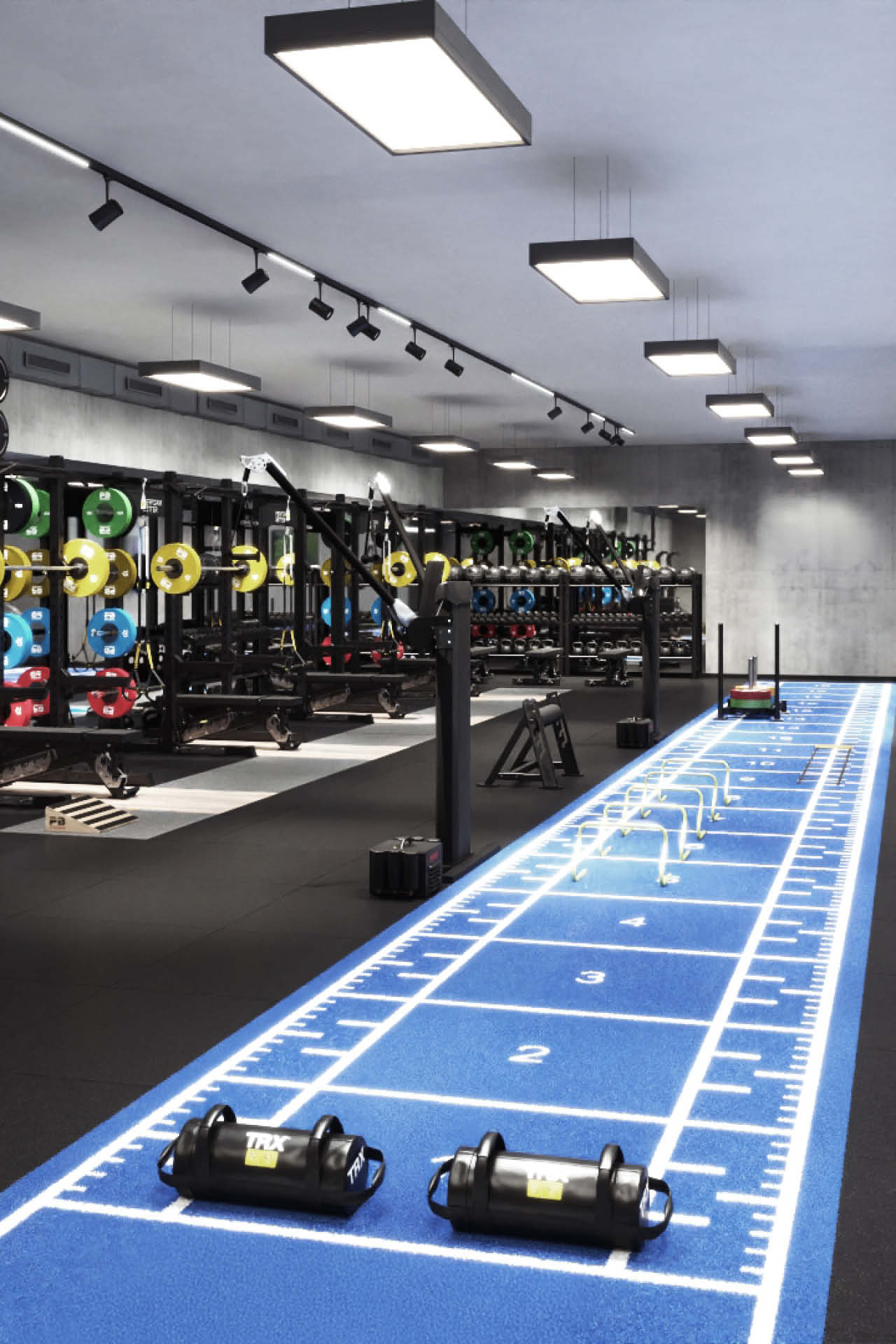
Thinking about training, getting back into exercise and recovery as a whole
Athletic development is not just about physical exertion. Recovery and a controlled approach to managing training load are just as important. That is why recovery and mobility facilities can also be usefully integrated into a training area. They provide opportunities for recovery sessions, flexibility training or activities relating to the preparation and follow-up of the actual training session.
Such a space can also be particularly relevant following injuries. In consultation with the treating specialists, physiotherapy-guided exercises or targeted rehabilitation training can take place there, for example. Using different levels of resistance, free weights, cable machines or functional equipment, exercises can be adapted to suit the individual’s current fitness level and gradually increased.
In this way, the training area can support various phases: from regular strength and athletic training, through recovery sessions, to controlled rehabilitation on the path back to sport-specific training.


More opportunities for athletic development
Having a dedicated training area therefore does more than simply expand the club’s offering with additional fitness facilities. It can specifically combine strength and athletic training with sport-specific training, create opportunities for mobility and recovery, integrate diagnostic assessments, and also be used as part of a supervised rehabilitation programme.
The key is not to cram as many different functions as possible into a single room. Rather, the space should be precisely tailored to the requirements of the club, the athletes and the training programme. This creates a training area that does not replace the sport itself, but rather builds on it where additional physical development, targeted training and recovery can make all the difference.