Where Should I Train My Personal Training Clients?
Most personal trainers begin their careers by training friends and family. At some point, the decision to become a certified personal trainer becomes more concrete, and the course is booked. Does this sound familiar? Then you probably know this feeling as well: you've earned your certification and can't wait to start training your own clients. But now you're faced with an important question: Where should I train my personal training clients?
In this article, we'll answer that question and share a few more helpful tips.
The Four Types of Personal Trainers
There are four different types of personal trainers: two flexible models, where training takes place either outdoors or in the client's home, and two location-based models, where clients are trained either in a fitness studio or at the trainer's own facility. Most personal trainers follow a similar path throughout their careers, gradually moving from one model to another.
At the Beginning of Your Career
Most personal trainers start with a combination of both approaches: they train clients outdoors in good weather and visit clients at home when the weather is bad. Both options have their own advantages and disadvantages.
Outdoor Personal Training
While some clients prefer training in a fitness studio, many enjoy exercising outdoors and spending time in nature. However, the weather quickly becomes the first challenge—very few people want to train outside in heavy rain. Outdoor personal training is therefore highly dependent on the weather. On the other hand, when conditions are good, nature offers many advantages. Besides the fresh air, the flexibility of different training locations makes it easy to create varied and engaging workouts. Whether in a park, a forest, or at outdoor fitness facilities, almost any outdoor space can become an open-air gym. Stairs, railings, and park benches can all serve as effective training equipment.
Before using public spaces, however, you should check whether you are allowed to train clients there. To provide effective sessions, you'll also want to bring some equipment with you. Depending on how much equipment you need, transporting it can become another disadvantage, since you'll have to carry it from one location to another.
This also means you'll most likely need a car, which leads to another drawback: travelling between locations increases your transportation costs and takes time that could otherwise be spent training additional clients at a fixed location. On the other hand, outdoor personal training involves very few fixed operating costs, which is a major advantage, especially at the beginning of your career.

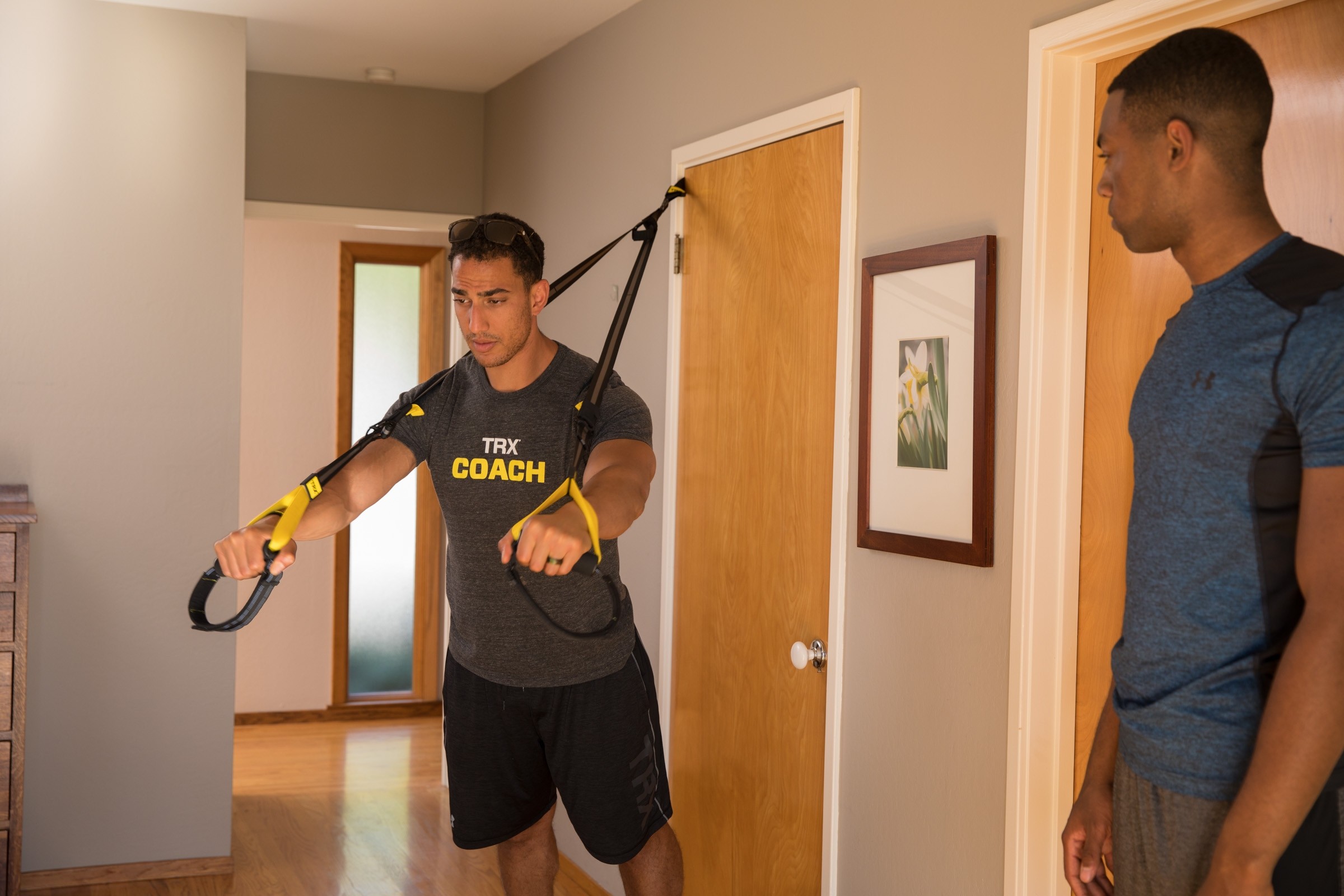
At the Client’s Home
Personal trainers who visit their clients at home are also familiar with the challenges of travel and higher transportation costs. The advantage here, however, is that training can take place within the client’s own home, even when it’s raining. That’s why a combination of outdoor training and sessions at the client’s home is very popular for those just starting their careers. In both cases, the equipment is already in the car—so you can decide spontaneously, depending on the weather, where the workout should take place.
The advantage here clearly lies with the client: They don’t even have to leave the house and can still do something for their fitness. This usually benefits mothers who don’t want to leave their children alone, or seniors who are no longer able to move around as well. However, a prerequisite for training at home is that there is enough space available or that space can be created by moving furniture if necessary. Of course, it would be ideal if the client had a home gym.
That way, you can combine the best of both worlds. You might already have guessed this, but at some point, every flexible personal trainer reaches a point where they want to spend less time driving. So now for the next step: the location-based personal trainer.
The Personal Trainer at the Gym
The Personal Trainer with Their Own Space